
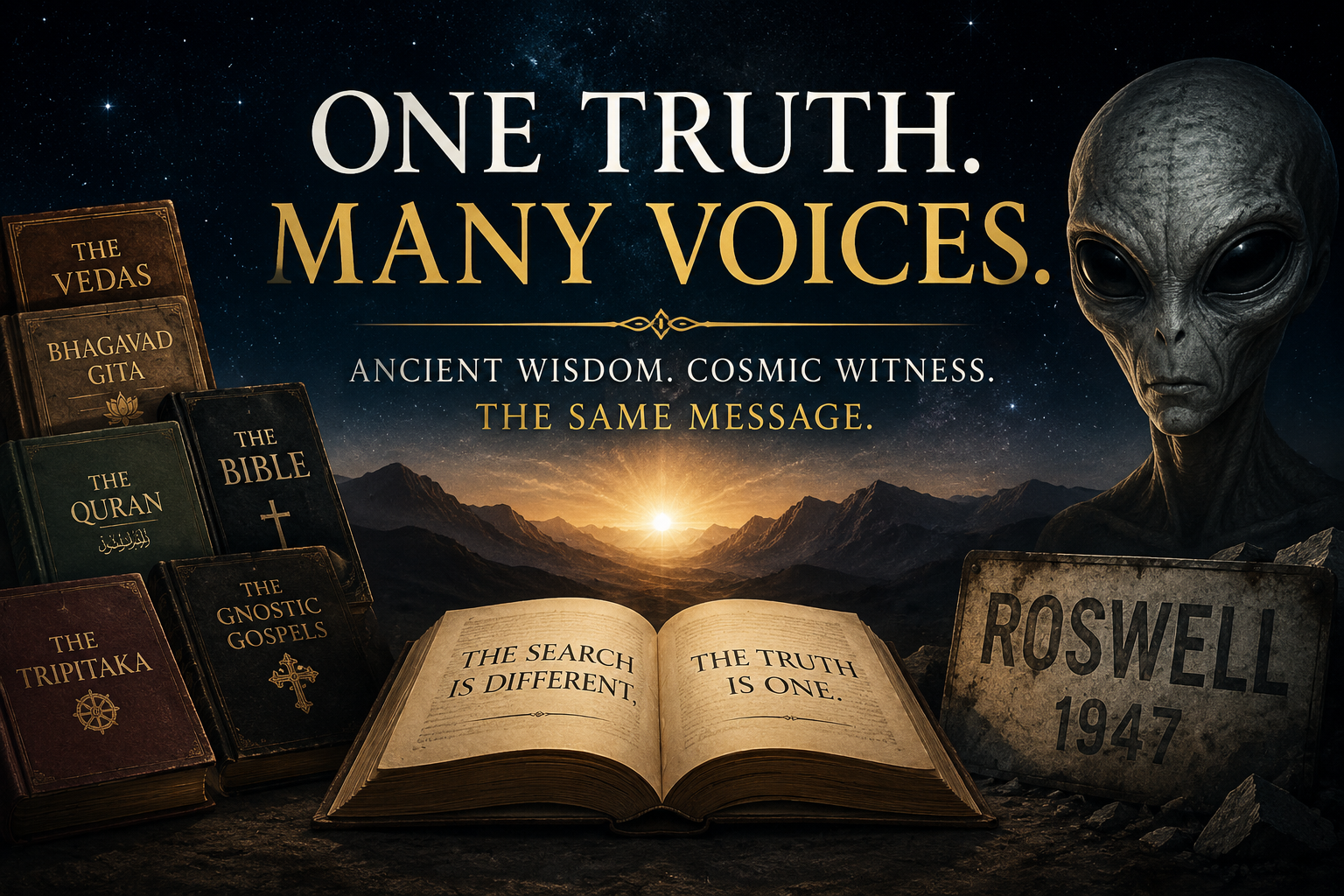
“Truth is one; the wise call it by many names.”
— Rig Veda
What if the greatest mistake humanity has made was believing that religions were competing with one another?
What if they were never meant to compete?
What if they were all trying to describe the same reality—using different languages, symbols, and cultural references?
This question stayed with me as I researched the alleged testimony of Airl, the being said to have survived the Roswell incident of 1947.
I approached the material with skepticism.
I didn’t want to prove aliens existed.
I wasn’t trying to validate conspiracy theories.
But something unexpected happened.
The deeper I explored Airl’s alleged testimony, the more familiar it became.
It didn’t sound entirely new.
It sounded ancient.
According to the account, human beings are not merely physical bodies. At our core, we are immortal spiritual beings who have forgotten our true nature. We live within a cycle of birth and death, repeatedly returning without remembering who we really are. Liberation comes not through blind obedience, but through awareness, knowledge, and remembering.
At first glance, these ideas seem extraordinary.
Until you open the world’s holy books.
The Upanishads tell us that the Atman—the true Self—is eternal and cannot be destroyed. The body dies, but the Self remains.
The Bhagavad Gita reminds Arjuna that just as a person changes worn-out clothes, the soul changes bodies.
Buddhism teaches that beings wander endlessly through Samsara, the cycle of birth and rebirth, driven by ignorance and attachment until awakening brings freedom.
The Gnostic texts speak of Archons—rulers who keep souls trapped in a world of illusion and forgetfulness, while liberation comes through Gnosis, direct knowledge of our true nature.
Ancient Egyptian texts provide guidance for navigating the journey after death, warning that awareness and preparation are essential.
Sufi mystics wrote about humanity’s deep homesickness—a longing for a home we cannot remember but somehow know exists.
Even early Christian thinkers like Origen believed in the pre-existence of the soul before such ideas were later rejected by orthodox institutions.
Different lands.
Different eras.
Different languages.
Yet the same themes appear repeatedly.
The soul is immortal.
This world is not ultimate reality.
Human beings have forgotten something essential.
Liberation requires awakening.
Can this simply be coincidence?
Perhaps.
Skeptics may argue that these similarities arise from common psychological patterns. Human beings everywhere ask the same questions about life and death, so naturally their answers overlap.
That is a reasonable explanation.
But another possibility deserves consideration.
What if these traditions preserved fragments of a forgotten truth?
Not the complete truth.
Not perfect truth.
But pieces of a larger puzzle.
Religions, after all, emerged in different cultural settings. Their symbols differ. Their rituals differ. Their methods differ. Yet beneath the surface, their mystical cores often point in the same direction.
Maybe the problem was never religion itself.
Maybe the problem began when humanity focused only on the outer forms and forgot to explore the deeper message.
We debated names while ignoring wisdom.
We argued over rituals while overlooking consciousness.
We defended identities while neglecting inquiry.
The sages of India called it Maya.
Buddhists called it ignorance.
The Gnostics called it forgetting.
Sufis described it as separation.
Airl’s testimony described it as amnesia.
Different words.
A remarkably similar warning.
This does not mean every sentence in every scripture should be taken literally.
Nor does it mean that Airl’s testimony must be accepted as historical fact.
In fact, certainty is the enemy of genuine inquiry.
The purpose of investigation is not to force belief.
It is to encourage deeper questions.
What if heaven and hell are not merely places, but states of consciousness?
What if salvation is not passive, but requires awareness?
What if enlightenment, moksha, nirvana, gnosis, and union with the Divine are not separate destinations but different names for the same realization?
And what if humanity has spent thousands of years preserving this wisdom, waiting for the moment when we would finally be mature enough to hear it without fear?
I don’t know whether Airl truly existed.
I don’t know whether the Roswell interviews happened exactly as described.
But I cannot ignore the extraordinary convergence between an alleged conversation from 1947 and spiritual insights preserved across thousands of years.
Perhaps the most important question is not:
“Which religion is right?”
Perhaps the better question is:
“What if they were all trying to remind us of something we have forgotten?”
Because if the sages, mystics, prophets, and seekers of every age were pointing toward the same truth, then humanity’s greatest spiritual task may not be conversion.
It may be remembrance.
And maybe the voice that spoke through ancient scriptures, through mystics in meditation, and through one mysterious testimony from Roswell, has been saying the same thing all along:
You are more than you have been taught to believe. Remember who you are.
Reflection for Today
If the deepest teachings of the world’s spiritual traditions all point toward the same truth, would it change the way you view religion—not as a division between people, but as different paths leading toward remembrance?
Share your thoughts below. Sometimes the most important discoveries begin not with answers, but with the courage to ask better questions.