
“Every myth carries a message. The question is whether we stop at the story or seek the truth it was trying to protect.”
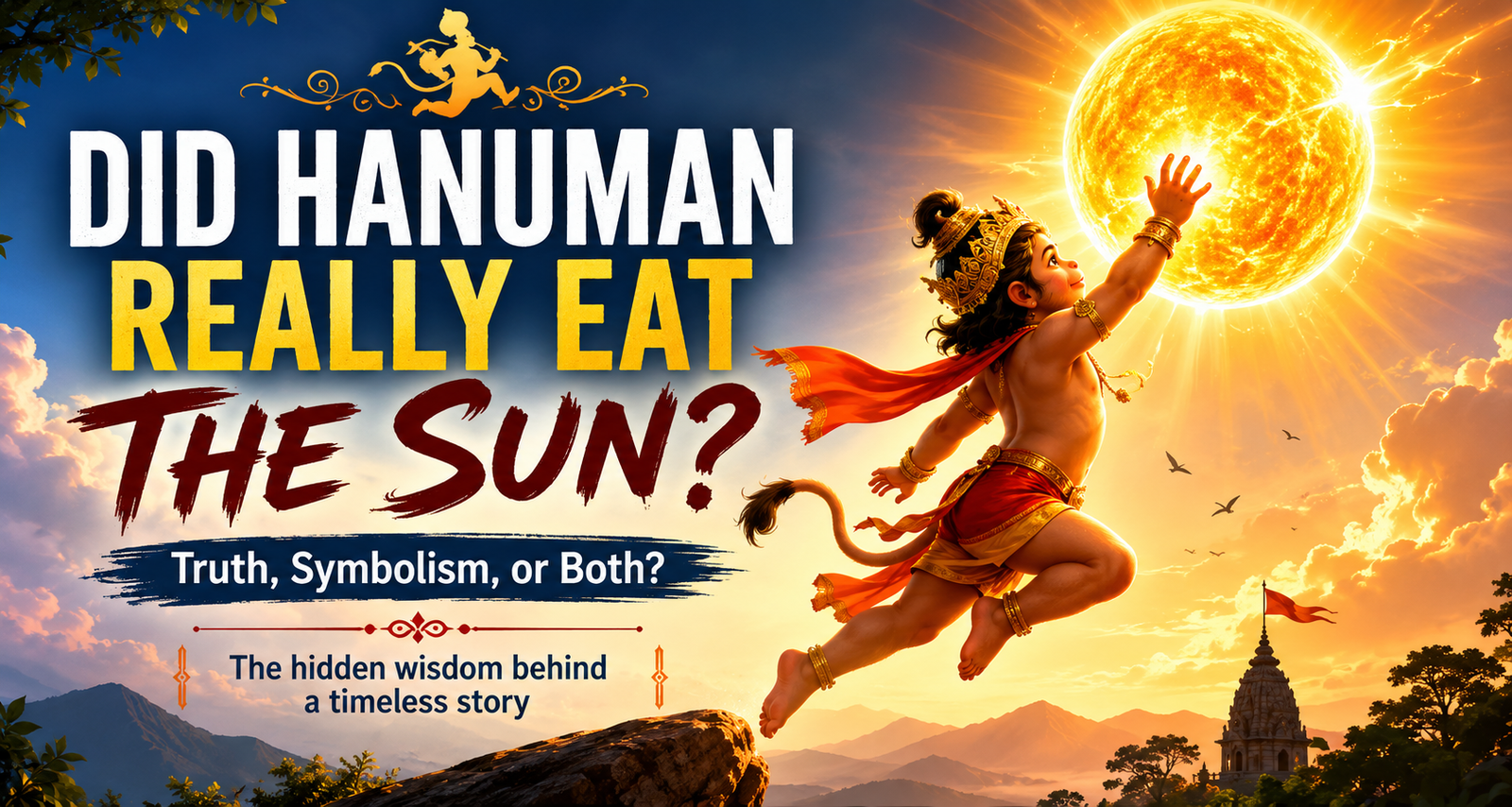
One of the most fascinating stories from Hindu tradition is that of young Hanuman attempting to eat the Sun.
As children, many of us heard it with wonder.
The story goes like this:
One morning, the infant Hanuman awoke hungry. Looking up at the sky, he saw the rising Sun glowing like a ripe, red fruit. Mistaking it for something delicious, he leapt into the heavens to eat it.
The gods were astonished.
Indra, the king of heaven, struck Hanuman with his thunderbolt to stop him. The blow injured Hanuman’s jaw, and the Wind God, Vayu, enraged by the harm done to his son, withdrew air from the universe. Life itself began to suffocate until the gods apologized and blessed Hanuman with extraordinary powers.
It’s a beautiful story.
But did it literally happen?
Did a monkey child actually jump into space and try to swallow the Sun?
Or is there something deeper hidden within this ancient tale?
Perhaps the answer is both simpler and more profound than we imagine.
The Literal View
For millions of devotees, the story is accepted as it is written.
Hanuman is not an ordinary being. He is considered an incarnation of divine power, blessed with abilities beyond human understanding. If the Divine can create the universe, devotees ask, why would such an event be impossible?
Faith does not always demand scientific explanation.
And for many, that faith itself is sacred.
The Symbolic View
Ancient Indian scriptures often communicated profound truths through stories and symbolism.
The Sun has always represented more than a celestial object.
In the Vedas and Upanishads, the Sun symbolizes:
- Knowledge
- Consciousness
- Divine illumination
- The highest truth
Young Hanuman’s leap toward the Sun may therefore symbolize something extraordinary.
It may represent the soul’s natural hunger for knowledge.
Unlike ordinary beings satisfied with worldly pleasures, Hanuman reaches for the highest light itself.
He doesn’t seek wealth.
He doesn’t seek power.
He seeks the Sun.
The source of illumination.
The Fearlessness of Innocence
Children possess a remarkable quality.
They don’t yet know what society calls “impossible.”
They dream without limits.
They attempt what adults are too afraid to imagine.
The infant Hanuman’s leap reminds us of that fearless innocence.
Before the world teaches us our limitations, we all possess an inner Hanuman—capable of extraordinary courage.
Unfortunately, most of us lose touch with it.
We stop leaping.
We settle for safety.
Hanuman never did.
Why Did Indra Strike Him?
This part of the story is equally important.
Every spiritual seeker eventually encounters resistance.
The path toward higher knowledge is rarely smooth.
Doubt appears.
Obstacles arise.
Criticism follows.
Failures humble us.
The thunderbolt may symbolize life’s challenges.
Not to destroy us.
But to mature us.
Hanuman’s injury did not weaken him.
It prepared him.
The gods later blessed him with immense strength, wisdom, and protection.
Sometimes life’s setbacks are not punishments.
They are initiations.
The Forgotten Power Within
There is another fascinating aspect of Hanuman’s story.
According to tradition, Hanuman eventually forgot the extent of his own powers due to a sage’s curse. Later, during the search for Sita, Jambavan reminded him of who he truly was.
Only then did Hanuman leap across the ocean to Lanka.
Think about that for a moment.
The greatest devotee in the Ramayana had forgotten his own strength.
Doesn’t that sound familiar?
How many of us have forgotten our courage?
Our potential?
Our wisdom?
Our divinity?
Perhaps Hanuman’s story is not merely about a heroic figure from the past.
Perhaps it is about us.
We are all powerful in ways we do not recognize.
And sometimes, all we need is a reminder.
So, Is It Truth or Symbolism?
Maybe this question itself is incomplete.
Ancient India did not separate history, philosophy, psychology, and spirituality as sharply as the modern mind often does.
A story could be true on multiple levels simultaneously.
It could preserve an extraordinary event.
It could communicate timeless wisdom.
It could inspire devotion.
It could guide inner transformation.
Its value was not measured solely by whether it could be tested in a laboratory.
Its value lay in whether it transformed the listener.
Perhaps the real miracle is not whether Hanuman ate the Sun.
Perhaps the real miracle is that thousands of years later, this story still inspires children to dream beyond limits, devotees to deepen their faith, and seekers to search for the light of knowledge.
And maybe Hanuman’s leap toward the Sun is an invitation.
An invitation to ask ourselves:
What is the Sun I have stopped reaching for?
The truth?
Wisdom?
Purpose?
God?
Whatever it may be, perhaps the childlike courage to leap toward it is the very quality our modern world desperately needs.
Because Hanuman’s greatest teaching was never about physical strength.
It was about remembering who we truly are.
And having the courage to rise toward the light.
Reflection for Today
Do you see Hanuman eating the Sun as a historical event, a spiritual symbol, or both?
Whatever your answer, ask yourself this:
What dream, truth, or calling have you been too afraid to leap toward?
Maybe it’s time to remember your inner Hanuman.